Law, Ethics, and News Literacy
Law
Free Speech
As student journalists, we have the right to publish columns that reflect our own personal opinions. However, we do not have the right to defame other people or to post known falsehoods, which means that everything on The Little Hawk represents what we, as student journalists, believe is the truth.
Copyright Laws
I learned about copyright laws the hard way. Two years ago, I published an article about City High's Environmental Club and how they were helping bring composting to the forefront of sustainability education. For that article, I took a morning off of school in order to follow Environmental Club to a local elementary school and take photos of their presentation.
I posted the photos on thelittlehawk.com with the rest of the article and thought nothing of it. Six months, however, I found the photos—the ones I had taken and published with my story about composting—on a student's nonprofit website. Although the student was involved in Environmental Club, the nonprofit was independent from Environmental Club, so they were using my photos with the intent to make people believe that the photos were of an event run by the nonprofit, not Environmental Club.
As student journalists, the question about who holds the copyright to your photos can be confusing. Even though my photos were published on thelittlehawk.com, I am not a paid employee, so I owned the copyright to my photos.
I felt protective over my photos. I compete in policy debate, and that year, our topic was intellectual property. I learned about how my photos were misused without my permission the week after I had returned from a monthlong debate camp, where I had dived deep into the world of IP law. It felt surreal to see the topic I had spent weeks learning about affect me directly. In addition, my parents are both intellectual property law attorneys, which meant that I had someone to talk with directly in a scenario like this.
I asked for the photos to be taken down, but they remained up for about a month. I ended up submitting a DMCA copyright complaint to the website host provider, because I felt that the way they had used my photos was not only infringing on my copyright, but was a misrepresentation of what they actually showed.
The website was taken down, and the nonprofit replaced the photos I had taken with photos from an event they had hosted, which was enough to make me happy. While I was able to recognize that my photos were being misused and my rights were being infringed upon, I acknowledge that I am in a specific position where I knew what to do in that instance. Other students—ones who hadn't just spent a month learning about intellectual property law and whose parents didn't teach law students IP law for a living—would not know how to take action, or even that they had the right to their own photos.
It's important that journalists, even student journalists, know that they own the words they write and the photos they take. Otherwise, their creations may be taken by others, just like mine were.
Ethics
Staff Manual
It's incredibly important for us to follow the Little Hawk Staff Manual. This is a living document—policies are added as needed, with the editorial board voting on whether or not they agree with a new policy.
If we don't follow the policies that us and former editorial boards have developed, it becomes increasingly difficult for us to tell right from wrong. If a staff member committed an ethics violation and we didn't have a staff manual, we wouldn't know how to react to the situation or take steps to have the member removed.
New Policies
I have developed two new policies in response to issues that occurred last spring and this fall. The first, our Fact-Checking policy, emerged after we faced allegations of a biased agenda during the City High student senate presidential election last spring.
As a publication, we decided to fact check the promises that each candidate made during the election and post them on Instagram. However, one candidate believed that our fact check posts favored a certain candidate, and posted about it on their campaign Instagram.
Worried about how this would affect student opinion of The Little Hawk, I decided to develop our fact check policy to keep us accountable and to avoid similar problems in the future. After creating it, the rest of the editorial board voted on it and it was added to the staff manual.
The second policy I created was an AI usage policy. This fall, there were worries that a staff member was using generative AI to write their stories for them. Since we didn't have a specific policy regulating AI usage, I realized that we needed to develop one, especially considering the massive advancements in artificial intelligence within the past few years.
Without a policy, we weren't able to take specific actions towards removing the member of the staff. However, after developing the new AI policy and voting to add it to the staff manual with the Editorial Board, we now have guidelines if we face a similar situation.
The two staff policies I developed are located below.
Fact-Checking Policy
At The Little Hawk, we follow a fact-checking process when we write articles and, if necessary, fact check political figures in our community. When selecting material to fact-check or write about, we strive to equally choose statements that represent multiple sides of an issue. Once we find a statement that we suspect may be inaccurate or misleading, we will do our best to find information that demonstrates whether or not the claim made is clear, accurate, and not misleading.
We follow the NSPA Code of Ethics for High School Journalists, which states that “accuracy requires putting the facts together in a context that is relevant and reveals the truth.” Little Hawk fact-checking strives to provide the background information, context, and facts to reveal the truth behind unclear statements.
We strive to balance individuals’ right to privacy and the public’s right to be informed. In general, fact-checks are done on influential figures who are influencing community, school, and public policy.
The Little Hawk’s mission is to reduce the level of confusion and deception in politics in our community, and we rely on primary source information and multiple credible sources from the internet in order to come to a conclusion. Our goal is always to use the best evidence possible. Most statements are not completely false or completely true, so we will use the terms “mostly” or “partially” true when rating claims.
Rating scale:
True
Mostly True
Partially True/Somewhat True
Misleading
Mostly False
False
AI Policy (updated 10/1/2025)
The Little Hawk is run by a team of dedicated City High students. Everything written—from a k-pop concert review to a basketball season breakdown—is based on lived experiences. Artificial Intelligence cannot replace that.
However, the Editorial Board acknowledges that in some cases, AI can be useful and even necessary. Reporters on The Little Hawk take full responsibility for the content that they produce, regardless of AI involvement. Generating content using artificial intelligence and crediting it to a student reporter’s name constitutes plagiarism under ICCSD School Board Policy, and replacing human quotes with content generated by artificial intelligence is quote falsification. Infractions on the AI policy are ethical violations and will result in actions towards staff dismissal.
Permitted Uses of AI
-
Editing photos when it does not change the purpose or message of the photo
-
Grammar and spell-checking articles
-
Suggesting story, editorial, or social media ideas
-
Suggesting possible interview questions
-
Transcribing interviews (if interviewee consents to recording)
-
Summarizing long reports
-
Suggesting headlines
-
Using as one tool to research background information, with the knowledge that it may be incorrect
-
Consulting AI to identify suitable interviewees based on the article’s topic.
Non-Permissible Uses of AI
-
Producing copy for content ranging from stories to cutlines except when commenting on AI use
-
Creating images, designs, or videos without clearly labelling it as such
-
Revising content
-
Replacing credible sources of information, such as original research articles, trusted interviews, or credible news outlets
Policy inspiration from Dragonfly Media, FHN Today, and JEA
Publication Errors
When we are notified of a publication error on thelittlehawk.com, we rectify it immediately and add a note at the bottom about the change. When I wrote Brain Drain, I incorrectly misinterpreted a quote I had obtained during an interview and made an assumption without double checking my work. However, once the article came out, I was notified by my source that I had made a mistake.
I have also started instituting a "Corrections" section in the print version of The Little Hawk. When we learn of past errors—usually simple name misspelling or date mixups—I write it down in a section of my notebook for the Corrections section in the next print issue.
Both the Corrections section and individual corrections on the web help keep us accountable. As student journalists, it's important for us to be as truthful as possible and never print mistruths that we know are wrong so that students know that we are a trustworthy source of news.

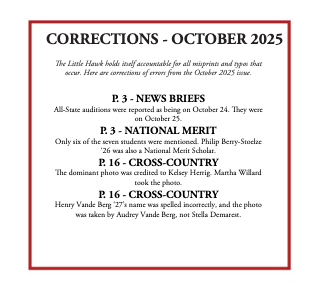
Above: The printed correction to Brain Drain
Right: The Corrections section from the November issue of The Little Hawk, with page numbers and explanations for each error in the October issue of The Little Hawk.
News Literacy
Recently, our students in Foundations of Journalism—the introductory course every student is required to take before joining a publication—learned about news literacy. To that end, each of them had to write a column on "trusted sources" for a topic they chose. It's especially important for our Foundations students to learn about news literacy, because they have to be able to think critically when writing an article and reading for research.
I am currently working on an in-depth news article about media literacy, with a specific focus on how students view the media. While researching for this story, I sent out a survey to the City High student body to gather data about what students view as trustworthy versus not trustworthy. What I learned was that most students rank traditional media as an eight on a scale from one to ten, with ten being the most trustworthy. However, 70.4% of students also believe that news outlets intentionally add bias to coverage to advance a specific agenda, and 57% of students believe that the quality of professional journalism has gone down in recent years.
In addition, I interviewed Christina Veiga, the senior director of media relations at the News Literacy Project, to learn more about a study she conducted on student media literacy. According to her, teenagers overwhelmingly associate the news with bias, polarization, and lying.
As student journalists, it is our responsibility to be a trusted source of news at our schools. We, while not professional journalists, can bring information to our student populations that students can know don't advance a specific perspective or agenda.
